

Modern DevOps demands more than basic automation—AI integration creates intelligent, adaptive systems that predict issues and optimize workflows. n8n excels as an open-source orchestrator, seamlessly linking GitLab, ArgoCD, monitoring tools, and AI services for smarter operations.
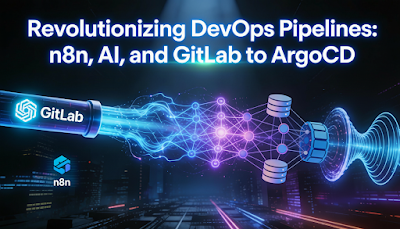 |
| Revolutionizing DevOps Pipelines: n8n, AI, and GitLab to ArgoCD |
AI’s Transformative Role in DevOps
AI elevates DevOps across multiple stages, from code generation to deployment.
Code Generation and Review
AI tools like GitLab Duo and Amazon CodeWhisperer auto-generate code, suggest fixes, and review pull requests for bugs or inefficiencies. In GitLab pipelines, AI scans diffs and proposes unit tests or refactoring.
n8n workflows trigger on GitLab merge requests, forwarding code to AI APIs for analysis, then posting comments directly back to GitLab.
Security and Compliance
AI-powered SAST/DAST tools identify vulnerabilities with fewer false positives, while secret scanning uses ML to validate credentials. Dependency scanners predict risks from outdated packages.
With n8n, security alerts from GitLab route to AI models for prioritization, notifying only critical issues via PagerDuty or Microsoft Teams.
CI/CD Optimization
In CI/CD, AI forecasts build failures from historical logs and suggests resource tweaks. Tools analyze ArgoCD syncs to prevent problematic rollouts.
n8n captures GitLab pipeline failures, sends logs to OpenAI or Anthropic for root cause summaries, and auto-triggers ArgoCD rollbacks if risks exceed thresholds.
Monitoring and AIOps
AI detects anomalies in metrics from Prometheus or Grafana, enabling self-healing like auto-scaling Kubernetes clusters. Predictive alerts reduce downtime by 50% in mature setups.
n8n integrates alerts with AI to parse logs, decide actions (restart pods or scale), and execute via ArgoCD APIs.
Deployment Intelligence
AI evaluates traffic patterns and past deployments to pick optimal windows, scoring rollout risks dynamically.
Before ArgoCD syncs, n8n workflows query AI with deployment history, delaying high-risk releases and notifying GitLab channels.
ChatOps Enhancements
Natural language queries in Slack or Discord yield AI-powered insights, like “Summarize last ArgoCD failure,” pulling from GitLab and logs.
n8n bots parse messages, fetch data via APIs, and respond with AI-generated explanations.
Why Choose n8n for DevOps?
n8n serves as a neutral orchestrator without built-in AI, focusing on 400+ integrations including GitLab, ArgoCD, OpenAI, and Kubernetes.
-
Self-hosted flexibility: Run on Docker or Kubernetes for data sovereignty.
-
No-code core with code extensibility: Drag-and-drop nodes plus JavaScript for custom logic.
-
Event-driven triggers: Webhooks from GitLab or schedules for cron-like jobs.
-
Scalable execution: Queue mode handles enterprise loads.
Unlike rigid tools, n8n adapts to hybrid stacks, chaining GitLab → AI → ArgoCD without vendor lock-in.
Pros and Cons Evaluated
| Aspect | Pros | Cons |
|---|---|---|
| Cost | Free core; scales without licensing fees. | Infrastructure costs for high-volume workflows. |
| Integrations | 400+ native nodes; HTTP for any API. | Custom nodes needed for niche tools. |
| Ease of Use | Visual editor suits devs and ops. | Complex graphs challenge debugging. |
| AI Support | Plugs into any LLM (OpenAI, Grok). | No native ML; relies on external calls. |
| Enterprise Fit | Kubernetes-ready; audit logs available. | May pair with ArgoCD for massive pipelines. |
n8n shines in mid-sized teams bridging GitOps and AI, but large orgs hybridize with dedicated CD like ArgoCD.
Key Benefits of AI + n8n
Teams see faster MTTR through AI log analysis, cutting incident response by 40-60%.
Predictive scaling prevents outages, while automated reviews free developers for innovation. Security improves with AI-filtered alerts, reducing noise.
Overall, cognitive load drops as ChatOps delivers instant insights, fostering a proactive culture.
Practical Workflow: GitLab PR to ArgoCD Deploy
Build an end-to-end pipeline: GitLab merge request triggers AI review, CI, and ArgoCD deployment.
Step 1: GitLab Trigger Node
Set up a webhook trigger for merge_request events in your GitLab project.
{
  "parameters": {
    "events": ["merge_request"],
    "gitlabUrl": "https://gitlab.com",
    "projectId": "your-group/your-repo"
  },
  "name": "GitLab Trigger",
  "type": "n8n-nodes-base.gitlabTrigger"
}
This captures PR details like diff and branch.
Step 2: AI Code Review
Extract diff via GitLab API, send to OpenAI for analysis.
Code Node (JavaScript):
const diff = $json.changes; // From GitLab payload
const prompt = `Review this diff for bugs, style, and tests: ${diff.slice(0, 4000)}`;
const aiResponse = await $http.post('https://api.openai.com/v1/chat/completions', {
  model: 'gpt-4o',
  messages: [{role: 'user', content: prompt}]
}, {headers: {Authorization: 'Bearer YOUR_KEY'}});

return [{json: {review: aiResponse.choices[0].message.content}}];
Post review as GitLab comment.
Step 3: Trigger GitLab CI Pipeline
Use HTTP Request to start pipeline with parameters.
{
  "parameters": {
    "url": "https://gitlab.com/api/v4/projects/{{$project_id}}/pipeline",
    "authentication": "genericCredentialType",
    "sendQuery": true,
    "queryParameters": {
      "parameters[BRANCH]": "={{$json.branch}}",
      "ref": "={{$json.branch}}"
    }
  },
  "name": "Run GitLab CI",
  "type": "n8n-nodes-base.httpRequest"
}
Monitor status with polling.
Step 4: ArgoCD Sync on Success
If CI passes, update ArgoCD application manifest and sync.
HTTP Request to ArgoCD API:
{
  "parameters": {
    "url": "https://argocd.example.com/api/v1/applications/your-app/sync",
    "method": "POST",
    "authentication": "genericCredentialType",
    "sendBody": true,
    "body": "{"revision": "{{$json.sha}}"}"
  },
  "name": "ArgoCD Deploy",
  "type": "n8n-nodes-base.httpRequest"
}
Fetch status and health.
Step 5: AI Risk Assessment and Notify
Before prod sync, AI scores deployment risk from CI artifacts and history.
Code Node:
const history = await $http.get('https://gitlab.com/api/v4/projects/.../pipelines?per_page=10');
const prompt = `Assess risk for deploy SHA {{$json.sha}} based on last 10 pipelines: ${JSON.stringify(history.data.slice(0,3))}`;
 // Call AI, parse score
if (score > 0.7) {
  await $http.post('https://slack.com/api/chat.postMessage', {channel: '#deploys', text: 'High risk - paused!'});
  return []; // Halt workflow
}
Slack/Discord notifications on completion.
Error Handling Branch
IF node checks CI status; on failure, AI summarizes logs.
IF Node: {{$json.status}} === 'success'
- True: Proceed to ArgoCD
- False: OpenAI log analysis → GitLab issue → Slack alert
This ensures resilience.
Advanced Extensions
-
Self-Healing: Prometheus alert → n8n → AI anomaly detect → ArgoCD rollback.
-
Multi-Cloud: Integrate AWS CodePipeline or Azure DevOps alongside GitLab.
-
GenAI Tests: Auto-generate Cypress/Playwright tests from PR descriptions.
-
Cost Optimization: AI analyzes cluster usage, suggests ArgoCD resource tweaks.
Scale with n8n’s queue mode on Kubernetes for 1000+ workflows daily.
Future Outlook
By 2026, expect n8n-like orchestrators with embedded agentic AI for fully autonomous DevOps. GitOps platforms like ArgoCD will natively support LLM hooks, but flexible tools like n8n ensure adaptability.
Teams adopting this stack report 3x faster deployments and 70% less toil. Start small: prototype a GitLab-to-AI review workflow today.
Reach out to neel@getcloud.in for more details on this project.

.png)