
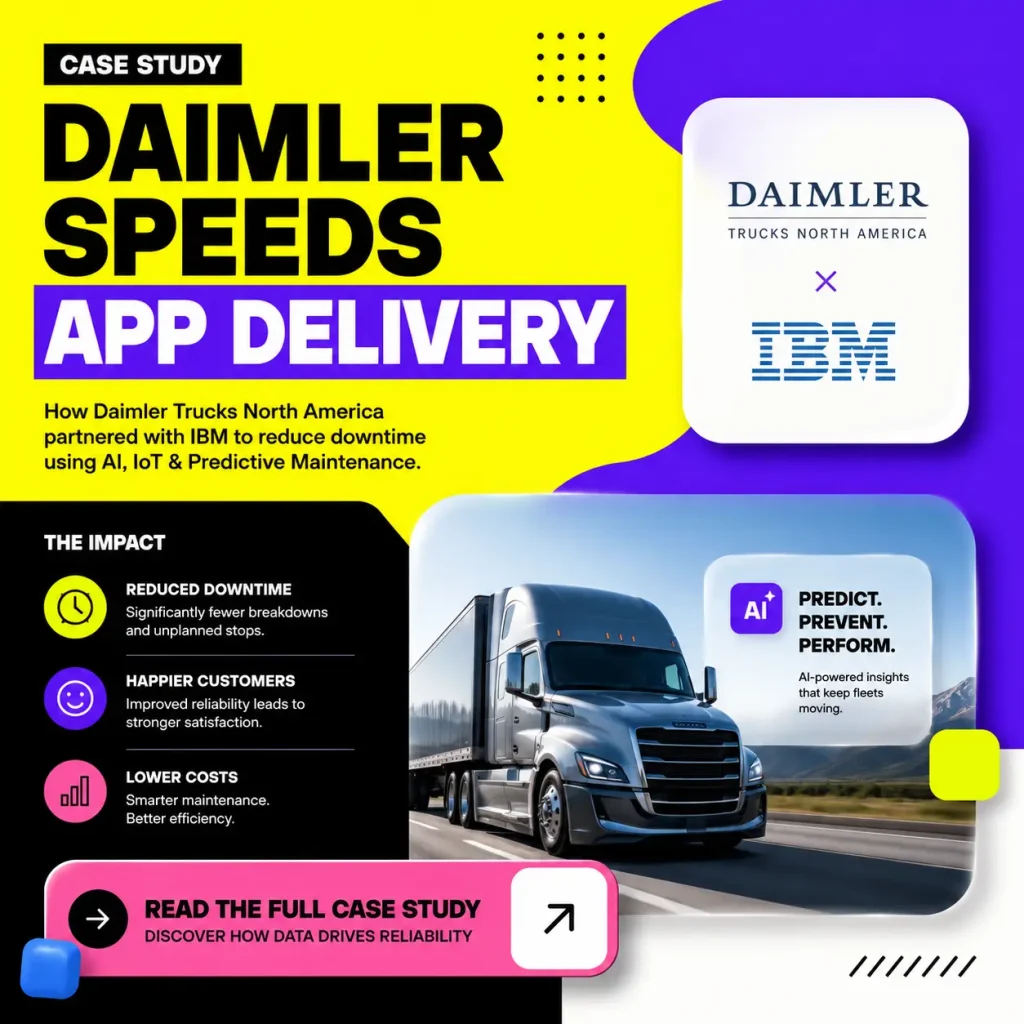
Discover how Daimler Trucks North America partnered with IBM to implement AI-powered predictive maintenance using IoT, cloud analytics, and data-driven insights. Learn the architecture, business benefits, and DevOps lessons behind this successful digital transformation.
How Daimler Trucks North America Reduced Vehicle Downtime with AI, IoT, and Predictive Maintenance: An IBM Case Study
The commercial transportation industry depends on reliability. Every hour that a truck remains out of service due to an unexpected mechanical failure translates directly into lost revenue, delayed deliveries, dissatisfied customers, and increased operational costs. For logistics companies operating hundreds or even thousands of vehicles, a single breakdown can disrupt an entire supply chain.
Traditionally, fleet maintenance relied on scheduled servicing or reactive repairs after a failure occurred. While these methods worked for decades, they often resulted in unnecessary maintenance or costly downtime because they lacked real-time insights into vehicle health.
With the rapid growth of connected vehicles, cloud computing, Artificial Intelligence (AI), and the Internet of Things (IoT), fleet operators now have access to an entirely different approach—predictive maintenance. Instead of waiting for a component to fail, predictive maintenance uses live sensor data and machine learning models to detect early warning signs, allowing organizations to fix problems before they become critical.
One of the most successful examples of this transformation comes from Daimler Trucks North America (DTNA). By partnering with IBM, the company implemented an intelligent predictive maintenance platform that combines IoT sensors, cloud analytics, and AI-powered insights. This initiative enabled DTNA to significantly reduce unexpected vehicle downtime, improve maintenance efficiency, lower operational costs, and enhance customer satisfaction.
This case study explores how IBM and Daimler worked together to modernize fleet maintenance, the technologies involved, the business challenges they addressed, and the lessons organizations can learn from this digital transformation.
Whether you are a DevOps engineer, cloud architect, software developer, IT manager, or business leader, this article demonstrates how AI, IoT, and cloud technologies can create measurable business value beyond traditional software applications.
About Daimler Trucks North America
Who Is Daimler Trucks North America?
Daimler Trucks North America (DTNA) is one of the world’s largest manufacturers of commercial vehicles. The company produces several well-known truck brands that serve industries such as logistics, freight transportation, construction, manufacturing, and public services.
Every day, thousands of Daimler trucks transport goods across cities, states, and international borders. Because these vehicles are critical to business operations, reliability is one of the company’s highest priorities.
Customers expect trucks to operate efficiently for long distances while minimizing fuel consumption, maintenance expenses, and unexpected breakdowns. Meeting these expectations requires more than building durable vehicles—it requires continuous monitoring, data analysis, and proactive maintenance strategies.
As modern commercial vehicles became increasingly connected through onboard sensors and telematics systems, Daimler recognized an opportunity to transform maintenance from a reactive process into a predictive, data-driven service.
The Importance of Fleet Reliability
Fleet operators calculate vehicle performance using several important metrics, including:
- Vehicle uptime
- Maintenance costs
- Fuel efficiency
- Driver productivity
- Delivery performance
- Customer satisfaction
- Asset utilization
Even a minor mechanical issue can quickly escalate into a major business problem if it causes a truck to stop unexpectedly on the road.
For example, consider a logistics company operating 1,000 trucks. If just 5% of those trucks experience unplanned breakdowns each month, the business may face:
- Missed delivery schedules
- Increased repair costs
- Emergency roadside assistance expenses
- Higher replacement vehicle costs
- Reduced customer trust
- Lower fleet utilization
- Revenue loss due to delayed shipments
Preventing these failures became a strategic business objective for Daimler.
The Business Challenge
Why Traditional Maintenance Was No Longer Enough
Before implementing predictive maintenance, many fleet operators followed one of two common maintenance strategies:
Reactive Maintenance
Reactive maintenance means repairing equipment only after it fails.
Although this approach avoids unnecessary servicing, it often leads to expensive breakdowns, emergency repairs, and significant vehicle downtime.
Common problems include:
- Engine failures
- Brake system failures
- Transmission issues
- Cooling system malfunctions
- Battery failures
- Sensor failures
Since failures occur unexpectedly, businesses cannot plan maintenance efficiently.
Preventive Maintenance
Preventive maintenance follows a fixed schedule.
For example:
- Replace engine oil every 10,000 km
- Replace filters every six months
- Inspect brakes every year
Although preventive maintenance reduces failures, it also introduces new problems.
Many components are replaced while they are still functioning correctly, increasing maintenance costs without delivering proportional benefits.
In other cases, a component may fail before its scheduled inspection, resulting in unexpected downtime despite following the maintenance schedule.
The Cost of Vehicle Downtime
Unexpected downtime impacts much more than repair expenses.
It affects the entire transportation ecosystem.
Some major consequences include:
Financial Losses
Every hour a truck remains unavailable reduces revenue while increasing operational costs.
Customer Dissatisfaction
Late deliveries reduce customer confidence and may result in lost business contracts.
Increased Maintenance Costs
Emergency repairs are typically more expensive than planned maintenance because they require urgent labor, spare parts, and roadside assistance.
Operational Disruptions
Unexpected failures force fleet managers to reorganize routes, assign replacement vehicles, and reschedule deliveries.
Safety Risks
Mechanical failures on highways increase risks for drivers, cargo, and surrounding traffic.
The Need for a Smarter Approach
Daimler recognized that every modern truck generates a massive amount of operational data.
Examples include:
- Engine temperature
- Fuel consumption
- Tire pressure
- Battery voltage
- Brake performance
- Oil pressure
- GPS location
- Engine vibration
- Speed
- Acceleration
- Driver behavior
- Ambient temperature
- Road conditions
Instead of using this data only for diagnostics after a failure occurred, Daimler wanted to analyze it continuously to identify hidden patterns that could predict future failures.
This required a platform capable of:
- Collecting millions of sensor readings
- Processing data in real time
- Combining historical maintenance records
- Applying artificial intelligence models
- Delivering maintenance recommendations before failures occurred
To achieve this vision, Daimler partnered with IBM.
Why IBM?
IBM has extensive experience in enterprise cloud computing, AI, analytics, and industrial IoT solutions. Rather than building a predictive maintenance platform from scratch, Daimler collaborated with IBM to leverage its expertise in handling large-scale data integration and advanced analytics.
The goal of the partnership was not simply to collect more vehicle data. The objective was to convert raw information into actionable insights that maintenance teams could use to make faster, more informed decisions.
IBM’s platform enabled Daimler to:
- Aggregate data from multiple vehicle systems
- Process high volumes of telemetry data
- Analyze historical maintenance records
- Detect abnormal operating patterns
- Predict component failures before they occurred
- Recommend maintenance actions based on risk
This shift transformed maintenance from a reactive process into a proactive, intelligence-driven operation.
Objectives of the Predictive Maintenance Initiative
Before beginning implementation, Daimler and IBM defined several strategic objectives.
Reduce Unplanned Vehicle Downtime
The primary goal was to detect mechanical issues early enough to schedule repairs before a breakdown occurred.
Improve Fleet Reliability
Reliable vehicles increase customer confidence while improving operational efficiency across transportation networks.
Lower Maintenance Costs
By repairing only components that genuinely required attention, Daimler could reduce unnecessary part replacements and labor costs.
Increase Customer Satisfaction
Customers benefit from fewer delivery delays, greater vehicle availability, and more predictable transportation services.
Enable Data-Driven Decision Making
Maintenance teams could replace assumptions with real-time analytics supported by AI-generated recommendations.
Key Challenges Before Digital Transformation
Although connected vehicles generate enormous amounts of data, extracting useful insights presents several challenges.
Data Was Stored in Multiple Systems
Vehicle sensors, maintenance records, warranty databases, GPS systems, and service reports often existed in separate systems, making comprehensive analysis difficult.
Limited Real-Time Visibility
Maintenance teams frequently discovered issues only after drivers reported unusual behavior or after a component had already failed.
Growing Data Volume
Modern trucks continuously generate telemetry data. Managing and analyzing millions of records each day requires scalable cloud infrastructure and advanced analytics.
Manual Decision-Making
Without predictive insights, maintenance planning depended heavily on technician experience rather than objective, data-driven recommendations.
Difficulty Identifying Failure Patterns
Mechanical failures often result from subtle changes that develop gradually over time. Traditional reporting tools struggle to detect these complex patterns across large fleets.
Why This Case Study Matters
The Daimler and IBM collaboration demonstrates how digital transformation extends beyond adopting new technologies. Success came from integrating connected devices, cloud platforms, AI models, and data analytics into everyday maintenance operations.
Instead of reacting to failures, the organization shifted toward anticipating problems before they affected customers. This approach reduced downtime, improved efficiency, and created a more reliable fleet while showcasing how data can become a strategic business asset.
For technology professionals, this case study also highlights broader trends shaping modern enterprises. As industries generate increasing amounts of operational data, the ability to collect, analyze, and act on that information becomes a key competitive advantage. The principles used in this transformation—real-time monitoring, intelligent automation, and predictive analytics—are applicable not only to transportation but also to manufacturing, healthcare, energy, and other sectors where equipment reliability is critical.