

Site Reliability Engineering (SRE) remains essential in 2026 for ensuring scalable, reliable systems amid AI-driven demands and cloud-native shifts. This roadmap outlines steps from beginner to expert, optimized for aspiring SREs targeting high-demand roles.
What is SRE in 2026?
Site Reliability Engineering applies software engineering to infrastructure and operations, balancing reliability with innovation. Originating at Google, SRE uses Service Level Objectives (SLOs) and error budgets to guide decisions.
Teams now integrate AI to improve predictive reliability and enable autonomous remediation, moving beyond reactive fixes. Demand surges with 75% of enterprises adopting SRE practices by 2027.
Core SRE Principles
SRE revolves around key principles like SLOs, SLIs, and error budgets to quantify reliability.
- Define SLIs (e.g., latency, availability) to measure service health.
- Set SLOs as targets, using error budgets to prioritize toil reduction over features.
- Embrace automation: 50% of SRE time targets non-manual work.
In 2026, principles evolve with AI-first observability for proactive issue detection.
Beginner Phase: Foundations (0–6 Months)
Build basics in systems, networking, and coding before SRE specifics.
Linux mastery covers processes, file systems, and shell scripting. Networking essentials include TCP/IP, DNS, firewalls, and load balancers.
Programming focuses on Python or Go for automation. Key tools: Git for version control, Docker for containerization.

Practice via personal projects like deploying a simple app on a VM.
Intermediate Phase: SRE Essentials (6–18 Months)
Dive into cloud, monitoring, and reliability practices.
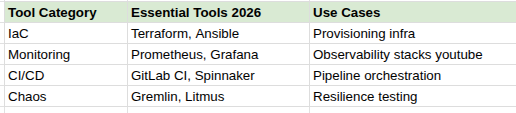
Cloud platforms like AWS EKS, GCP, or Azure emphasize auto-scaling and Kubernetes. Monitoring stacks: Prometheus for metrics, Grafana for dashboards, alerting with PagerDuty.
Implement CI/CD using Jenkins, GitHub Actions, or ArgoCD. Learn SLO modeling and basic incident response.
- Build CI/CD pipelines from scratch.
- Set up observability for a microservice.
- Conduct simple chaos experiments with tools like Chaos Mesh.
Trends show 40% of organizations using chaos engineering by 2025, improving MTTR by 90%.
Advanced Phase: Scaling Reliability (18–36 Months)
Master distributed systems, automation, and incident management.
Focus on SLOs/SLIs for prioritization, advanced Kubernetes with Helm for deployments. Incident management includes runbooks, postmortems, and root cause analysis using five whys.
Automation scripting in Python/Go integrates IaC like Terraform. Dive into databases (SQL/NoSQL), caching (Redis), and service meshes (Istio).
Integrate security: OAuth, encryption, firewalls in designs.
Expert Phase: Leadership & Innovation (3+ Years)
Lead with system design, AI integration, and mentoring.
Design large-scale distributed systems using microservices, consensus algorithms (Raft, Paxos). Drive SRE culture through mentoring juniors and cross-team collaboration.
2026 trends: AI/ML for predictive failure detection, self-healing systems, AIOps for capacity planning. Edge computing demands decentralized monitoring.
- Influence architecture for business-aligned reliability.
- Automate remediation with AI playbooks.
- Champion security in SRE pipelines.
Key Tools & Technologies 2026
SRE toolkits evolve with AI and serverless.
Monitoring: Prometheus + Grafana core, AI-enhanced like Dynatrace. Cloud-native: Kubernetes, serverless (Lambda), event-driven architectures.
Security: PKI, TLS, intrusion detection. Analysis: Correlation tools, first principles thinking.
2026 Trends Shaping SRE
Predictive autonomy via AI leads, with AIOps reducing reactive work. Integrated security and business-aligned SLOs dominate.
Chaos engineering standardizes resilience; edge/serverless shifts ops paradigms. Self-healing and SRE security automation cut MTTR.
Daily SRE Tasks
Senior SREs check platforms (EKS clusters), validate Docker/K8s, monitor SLIs, handle incidents, automate toil.
On-call involves triage, postmortems, and SLO reviews.
Certifications & Learning Path
- Google SRE Professional Certificate.
- CKAD/CKA for Kubernetes.
- AWS/GCP DevOps certs.youtube
Roadmap: Foundations → Cloud/Monitoring → Advanced Practices → Leadership. Hands-on projects essential.
Job Market & Salary 2026
SRE roles boom with digital demands. US averages $150K-$250K; India ₹20–50LPA for seniors. Focus resumes on SLOs, incidents, and automation.
Soft Skills for SRE Success
Communication shines in postmortems, presentations. Problem-solving, humility, navigating ambiguity key.
Collaborate across teams; XY problem avoidance is vital.
Getting Started Action Plan
- Master Linux/networking (1 month).
- Learn Python/Docker/K8s (2–3 months).
- Build a monitoring/CI/CD project (3 months).
- Contribute to open-source, simulate incidents.
- Network on LinkedIn, apply for junior roles.
Track progress with personal SLOs. In 2026, AI tools aid in debugging prompts effectively and validating outputs.
